Home ❯ Insights ❯ Preservation of thin tephra

On this page

Share on:
2 Minute Read
Emeritus Prof. Russell Blong

Preservation of thin tephra

by Russell Blong , Neal Enright and Paul Grasso.

Abstract:  The preservation of thin (<300 mm thick) tephra falls was investigated at four sites in Papua New Guinea (PNG), Alaska and Washington, USA. Measurements of the variations in the thickness of: (i) Tibito Tephra 150 km downwind from the source, Long Island (PNG) erupted mid-seventeenth century; (ii) St Helens W tephra (erupted 1479–80 A.D.) on the slopes of the adjacent Mt. Rainier in Washington State; (iii) Novarupta (1912) tephra preserved on Kodiak Island (Alaska, USA); and (iv) an experimentally placed tephra at a site near Mt. Hagen (PNG) allow tentative conclusions to be drawn about the relative importance to tephra preservation of slope gradients, vegetation cover and soil faunal activity. Results for the experimental tephra suggest that compaction occurs rapidly post-deposition and that estimates of tephra thickness and bulk density need to indicate how long after deposition thickness measurements were made. These studies show that erosional reworking of thin tephra is not rapid even on steeper slopes in high rainfall environments. In Papua New Guinea a 350-year old tephra is rarely present under forest but is well-preserved under alpine grasslands. On Mt. Rainier 500-year old tephra is readily preserved under forest but absent under grasslands as a result of gopher activity. Despite the poor relationship between tephra thickness and slope steepness the thickness of thin tephras is highly variable. On Kodiak Island thickness variability across a few metres is similar to that observed across the whole northeast of the island. The measured variability reported here indicates large sample sizes are necessary to adequately estimate the mean thickness of these thin tephra. These results have implications for the preparation of isopach maps, estimation of tephra volumes and elaboration of the potential consequences of tephra falls.
Read entire article

About the author/s

No Speakers found.

Further reading

Figure 2 main picture .2
14 Minute Read

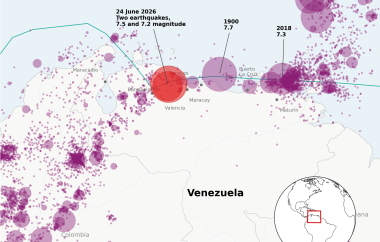
The 24 June 2026 Venezuela Earthquake Doublet

On 24 June 2026, northern Venezuela experienced a rare and damaging earthquake doublet near...
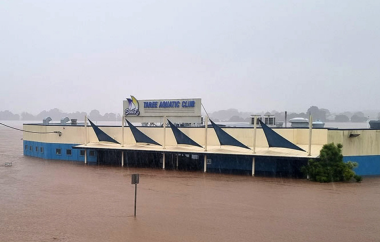
The Taree Aquatic Club during the Mid North Coast and Hunter floods looking toward the severely impacted suburb of Glenthorne on the far bank (Image shared with Risk Frontier's survey team by member of Aquatic Club cleanup staff).
6 Minute Read

Australia’s Most Costly Perils of 2025

Rising extinction risk is increasingly driven by human-made threats, especially emerging technologies like AI....
Confluence of Risks Nuclear War and Global Existential Threats - Risk Frontiers
7 Minute Read

Confluence of Concerns about the Risk of Nuclear War

Rising extinction risk is increasingly driven by human-made threats, especially emerging technologies like AI....

Interested in learning more about our detailed Australian bushfire & grassfire loss model?

The latest release of FireAUS, modelling bushfire and grassfire risk across Australia, represents another leap forward in the quantification of risk at the location and portfolio level. Risk Frontiers are the local, Australian-based experts and have used our recognised artificial intelligence, machine learning and climate modelling capabilities, decades of peer reviewed research and on the ground post-event surveys to continue to evolve our leading edge fire loss model.

Soon to be released FireAUS 4.0 will continue from FireAUS 3.2’s Australia wide coverage at the individual address level and can report losses at address level, SA1, postcode, and Cresta zones.

Our team is ready to answer your questions.

 In the spirit of reconciliation, Risk Frontiers acknowledges the Traditional Custodians of the land throughout Australia and their deep connections to land, sea, and community. We pay our respects to their Elders, past and present, and extend that respect to all Aboriginal and Torres Strait Islander peoples today.